The Gravel Gap: Why Sand, Stone, and Proximity Are the Quiet Core of US Resource Security
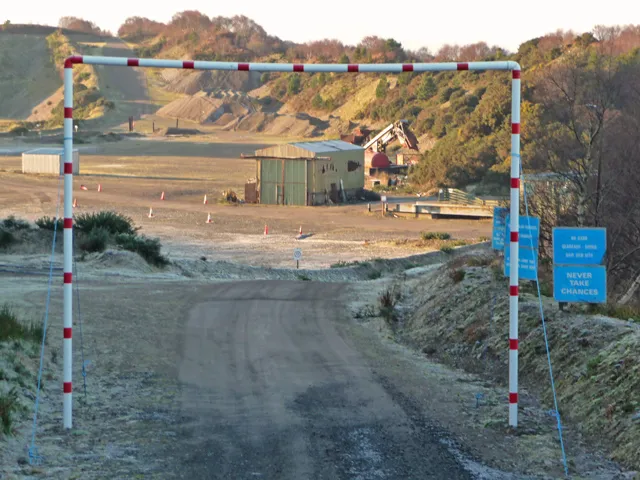
Photo: John Allan, CC BY-SA 2.0, via Wikimedia Commons
America's critical-minerals conversation tends to focus on lithium, cobalt, rare earths, and copper. Those minerals matter. But the resource that literally underpins the built environment is far less discussed: construction aggregates. Sand, gravel, and crushed stone are the highest-volume minerals in the US economy. They are used in roads, bridges, airports, water systems, foundations, and concrete. Without a reliable local supply, infrastructure spending becomes slower, more expensive, and more vulnerable to disruption. That is a resource security story hiding in plain sight.
The Invisible Mineral Economy
Aggregates are heavy, low-value per ton, and difficult to substitute. That combination makes them intensely local. A quarry or sand-and-gravel operation cannot simply relocate to another continent when demand rises. Transport costs are a large share of delivered price, so a source fifty miles away may be economically preferable to a source five hundred miles away even if the distant source has better quality. In practice, aggregates markets are regional and often constrained by the nearest permitted reserve.
This is why aggregates rarely appear in national critical-minerals lists. They are not scarce in a geological sense. But they can be scarce in an economic and regulatory sense. A metropolitan area may have plenty of stone beneath it, yet no permitted quarry within a reasonable distance. The result is longer truck trips, higher costs, more road congestion, and greater emissions per ton delivered.
Proximity Is the Product
For aggregates, the reserve is only half the asset. The other half is the permit, the haul route, and the relationship with the community. A quarry near a growing market can enjoy a durable cost advantage because it avoids long-haul freight. That advantage is difficult to replicate once competing reserves are built out or blocked. Operators that secure strategic reserves near growth corridors are effectively locking in a position that becomes more valuable as local supply tightens.
Transport economics reinforce this point. Rail can move aggregates long distances where volumes are large and terminals exist, but most construction markets depend on trucks. Longer hauls mean more vehicles, more fuel, more road wear, and more exposure to congestion. For public agencies, the delivered cost of stone can vary significantly depending on the distance from the nearest active quarry. For private developers, aggregate availability can affect project schedules as much as prices.
Permitting and Community Resistance
Aggregates operations face a distinctive permitting challenge. They are not remote projects; they are often proposed near the communities they serve. That proximity creates noise, dust, truck traffic, and visual impacts that can generate opposition. Even when a site is geologically suitable and zoning permits extraction, community acceptance can determine whether the project advances.
This is not simply a public-relations problem. It is a supply-chain risk. When local quarries are delayed or denied, construction projects draw from farther away. The cost is passed through to roads, schools, and housing. Yet the benefits of local supply are diffuse, while the impacts are concentrated near the site. That asymmetry makes aggregates permitting politically difficult.
Securing Reserves Near Growth Markets
Operators can respond by treating reserve acquisition as a long-term strategic exercise. The best sites combine quality material, favorable geology, reasonable haul routes, and a planning environment that can support extraction. That may mean acquiring land years before demand arrives, or securing options on parcels that are not yet zoned for mining. It also means understanding local transportation plans, because a new highway interchange or rail spur can change the economics of a deposit.
There is also a role for technology. Better modeling of deposits, automated loadout, and dust-control systems can improve efficiency at existing sites and reduce the footprint of new ones. But technology cannot overcome a missing permit or a hostile local government. The strategic work is social and regulatory as much as geological.
Winning Support Through Visible Benefit
Operators that engage early with residents and local officials can reduce friction. That means explaining truck routes, operating hours, dust controls, and reclamation plans before a formal application. It also means demonstrating tangible local benefits: tax revenue, employment, road improvements, and reliable supply for public projects. Community advisory arrangements, transparent monitoring, and commitments that outlast the permit can build credibility.
None of this guarantees approval. But it improves the odds and reduces the risk of costly appeals. In a sector where the nearest competitor may be hundreds of miles away, the ability to permit and operate a local site is a genuine competitive advantage.
The Strategic Lens
Aggregates may not have the geopolitical drama of rare earths, but they are central to America's ability to build and maintain infrastructure. A nation that cannot supply sand and stone near its growth markets will pay more, build slower, and depend on longer supply chains. The quiet core of resource security is not only what comes out of the ground; it is how close to the ground it comes out, and whether the community and the regulator will allow it. For US mining operators, that makes aggregates a story worth telling and a reserve position worth defending.